Is partisan gridlock leading to a national debt crisis?
The New York Times recently cited rancorous partisanship as one of the chief causes of America's skyrocketing national debt. Running $1.4 trillion budget deficits and having increased the debt ceiling to approximately $14 trillion, our nation is headed toward certain fiscal disaster unless a major policy shift is enacted. And while Republicans and Democrats continue to point fingers at one another, the debt spirals out of control.
Democrats complain that the Bush administration and the Great Recession forced them to help pass a $700 billion Wall St bailout, author a $787 billion stimulus package, and commit to trillion dollar deficits for years to come. But, before the financial crisis hit, a Democratic Congress approved huge budget deficits under President Bush in 2007-2008. And what about President Obama's record $708 billion military budget, which is larger than Bush's record breaking "defense" budgets? Surely that isn't Bush's and the Republicans' fault?
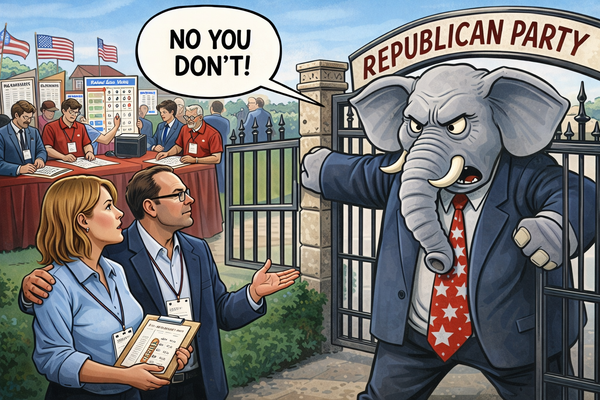
Republicans claim to have rediscovered their fiscally conservative platform once again, with Democrats in power, even though they added trillions to the national debt, couldn't balance the budget, and devalued the Dollar during the Bush years. Suddenly, running up the debt, breaking the budget, and hurting the value of the Dollar are anathema. But, many Republicans counter, "At least it wasn't as bad as what Obama and the Democrats are doing now". So much for high expectations.
Simply put, Democrats don't have the will to solve the debt crisis. Why? Because they won't cut Social Security, Medicare, Medicaid, and the military budget, each of which are going through the roof. Tax hikes are considered as a potential remedy, but serious spending cuts are not.
Republicans don't have the will to solve the debt crisis, either. Why? Because, as was made abundantly evident during their six year reign (Bush-Republican Congress), they increased both foreign and domestic spending. Tax cuts are championed as the leading panacea, but tax cuts without spending cuts led to trillions of dollars of additional debt during the Bush years.
In addition, neither party advocates serious cuts because the majority of economic pundits claim that America will fall into the Second Great Depression if massive government spending and stimulus programs are taken away prematurely. A brief stint of intense, short-term pain, much like the fleeting Depression of 1920-21 is seemingly out of the question for politicians, especially during an election year, even though it is highly probable that a bout of short-term pain is necessary to right the ship.
As a result, America hurtles down the path of financial self-destruction. Already, our 10% deficit to GDP ratio is right in the range of the European nations (i.e. Greece, Portugal, Spain, etc) on the brink of a debt crisis. China, our biggest lender (at least until December), is beginning to dump its Dollar reserves, which have served as the fuel for our insatiable borrowing spree. The warning signs of an impending debt crisis couldn't be any clearer.
Before it's too late, perhaps we could apply a few lessons from the Eisenhower and Clinton years. Without going into the fiscal details, President Clinton was able to balance the budget in the late '90s with a Republican Congress, and President Eisenhower was able to balance the budget and pay down some debt with a Democratic Congress in the late '50s. During the Clinton era balanced budgets, the rate of domestic spending slowed down, the military budget was cut (though the US still had the most powerful military in the world), the US Dollar was strong, and unemployment was low. During the Eisenhower era balanced budgets, the military budget was cut, domestic spending was sensible (though Medicare & Medicaid didn't exist), the US Dollar was strong, and the Five-Star General warned against the rising cost and influence of the military-industrial complex.
Therefore, in response to the New York Times piece, I would argue that partisan gridlock is not to blame for this nation's debt crisis. A Democratic President and a Democratic Congress aren't getting the job done. Formerly, a Republican President and a Republican Congress didn't get the job done. The Clinton-Eisenhower eras reveal that deadlocked parties can generate balanced budgets, though it didn't happen during the Bush-Pelosi-Reid tenure from 2007-2008.
If the debt crisis is to be bravely confronted, I believe it will require a revolution of sorts to restore fiscal sanity. A new party will have to emerge, a well-funded Independent candidate will have to arise out of nowhere, or a genuine "outsider" will have to break the stranglehold of one or both major parties, as well as the mainstream media. Some claim Sarah Palin, the Tea Party*, and the Liberty movement are vying for a revolutionary role in 2010 and 2012, but thus far, it would seem that Palin and the competing movements are too cozy with the GOP to make a clean break.
Even more important than a new party, renegade Independent, or political outsider will be the American people. Will we possess the courage, vision, and critical thinking skills to chart a new course? Will we have the intestinal fortitude to make the tough decisions? Will we take a step back from the incessant, partisan vitriole promulgated by the likes of Rush Limbaugh, Keith Olbermann, Sean Hannity, Chris Matthews, Bill O'Reilly, and Rachel Maddow, and actually think for ourselves?
If we will, then we may be able to turn the tide and get America back on track.
*Editor's note: for a more positive perspective of the Tea Party, read here.